PAMM vs MAM vs Copy Trading: What's the Difference?
Copy Trading vs PAMM vs MAM Accounts Explained These three terms get used as if they're interchangeable. They aren't. Choosing the wrong one means handing over more control of your money than you meant to — or less support than you needed. The difference comes down to one question: who holds your funds, and who makes the trading decisions? Get that clear and the choice becomes obvious for your situation. This breaks down PAMM vs MAM versus copy trading in plain terms, so you know exactly what you're signing up for. The One Distinction That Matters Most All three let someone else's trading skill drive your account. They differ on custody (where your money physically sits) and control (how much say you keep). That's the axis everything else hangs on. PAMM — your money joins a pooled fund; a manager trades it; you're hands-off. MAM — similar to PAMM but with more flexible allocation; still manager-driven. Copy trading — your money stays in your own account; trades are replicated; you keep control.

Daniel Brooks
Social Media Manager · July 25, 2026
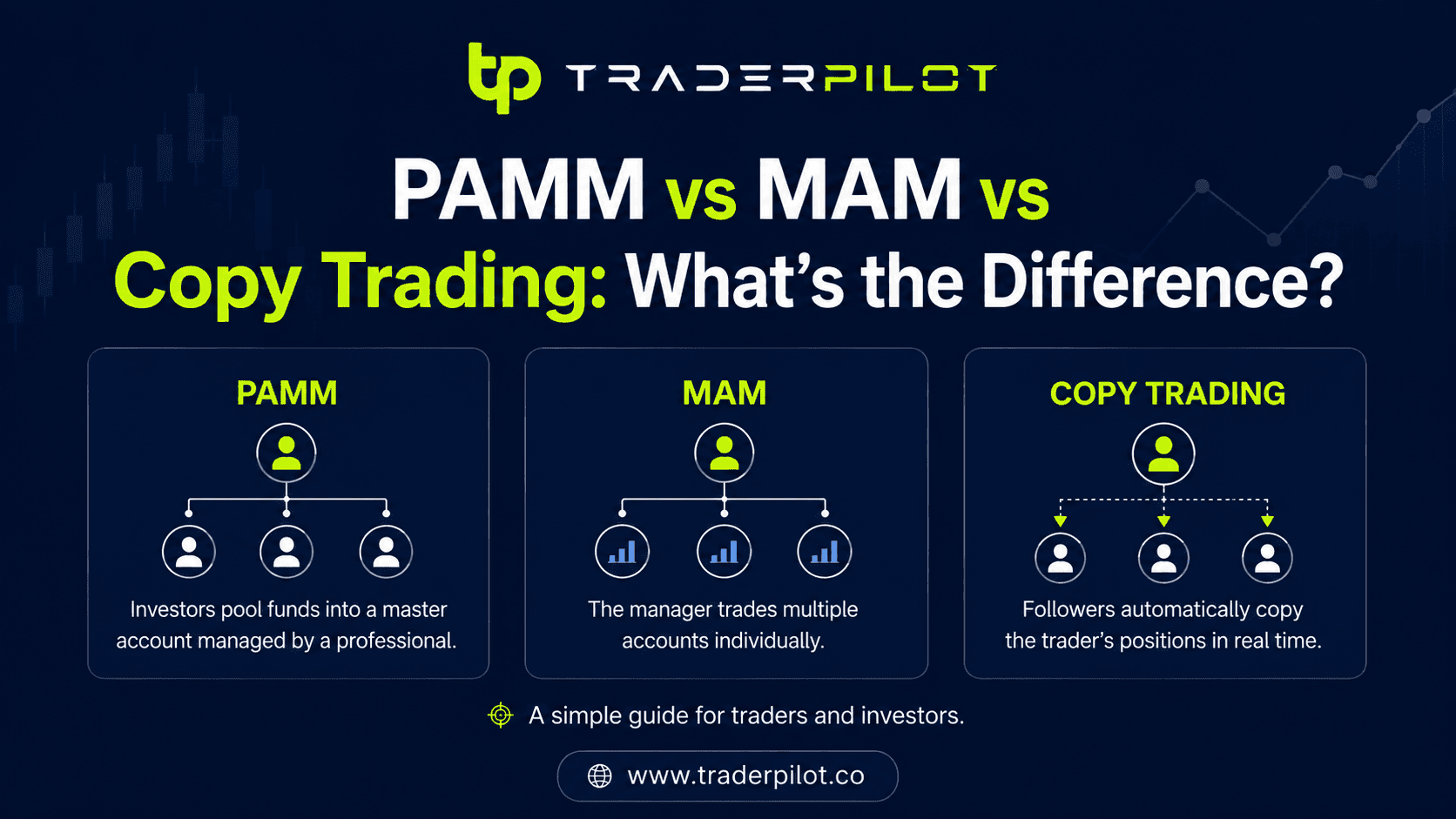
Table of contents
- PAMM Accounts Explained
- A PAMM (Percentage Allocation Management Module) account pools money from multiple investors into a single fund that a professional money manager trades. Profits and losses are distributed to each investor based on their percentage share of the pool.
- MAM Accounts Explained
- Copy Trading Explained
- Copy trading replicates a chosen trader's positions in your own brokerage account. Your funds never leave your control — the trades are mirrored, not managed on your behalf.
- Side-by-Side Comparison
- Which One Should You Choose?
- Common Mistakes When Choosing
- The Takeaway
- Frequently Asked Questions
- Keep control. Keep the edge.
PAMM Accounts Explained
A PAMM (Percentage Allocation Management Module) account pools money from multiple investors into a single fund that a professional money manager trades. Profits and losses are distributed to each investor based on their percentage share of the pool.
If you contribute 10% of the pooled capital, you receive 10% of the profit — and absorb 10% of the loss. The manager makes every decision. You choose the manager and the amount; after that, you're a passenger.
Best for: investors who want genuinely hands-off exposure and are comfortable delegating fully.
The trade-off: low control and lower transparency. You typically see aggregate results, not every individual trade, and your capital is tied up in the manager's pooled structure.
MAM Accounts Explained
A MAM (Multi-Account Manager) account also lets a manager trade on behalf of multiple investors, but with more flexible allocation. Instead of strict percentage splits, the manager can assign different lot sizes or risk levels to different accounts within the group.
MAM is essentially a more configurable cousin of PAMM. It's popular with managers running many clients who need per-account customization, and with investors who want a managed structure but slightly more tailoring than a rigid pool allows.
Best for: investors comfortable with delegation who want more flexible allocation than PAMM offers.
The trade-off: still manager-controlled. You're choosing the manager, not the trades.
Copy Trading Explained
Copy trading replicates a chosen trader's positions in your own brokerage account. Your funds never leave your control — the trades are mirrored, not managed on your behalf.
This is the key structural difference. With PAMM and MAM, your capital sits inside the manager's structure. With copy trading, your money stays in your account with your broker, and you can adjust risk, pause copying, or close positions yourself at any time.
Signal copiers — including Telegram-to-MT5 copiers — sit here. You follow a provider or channel, and software executes their calls on your account with your risk settings.
Best for: independent traders who want automation and someone else's edge without giving up custody or control.
The trade-off: you carry more responsibility. Sizing, risk caps, and dropping bad providers are on you.
Side-by-Side Comparison
| Factor PAMM MAM Copy Trading | |||
| Who holds your funds | Manager's pool | Manager's structure | You |
| Who makes decisions | Manager | Manager | Provider (you can override) |
| Your control | Low | Low–medium | High |
| Transparency | Aggregate results | Aggregate + allocation | Every trade visible |
| Allocation flexibility | Fixed % | Flexible per account | You set your own risk |
| Can you pause/exit fast? | Limited | Limited | Yes, anytime |
| Best for | Fully hands-off | Managed + tailored | Independent, hands-on |
Which One Should You Choose?
Match the model to how involved you want to be and how much control you're willing to give up.
- Choose PAMM if you want to fully delegate and are comfortable with a pooled, hands-off structure.
- Choose MAM if you want managed trading but need per-account flexibility — often the case for larger or customized allocations.
- Choose copy trading if you want to keep your money in your own account, see every trade, and retain the ability to adjust risk or exit instantly.
For most independent retail traders following Telegram or social signal providers, copy trading is the natural fit. It offers the automation of a managed account without surrendering custody or the ability to pull the plug.
Common Mistakes When Choosing
- Confusing custody with performance. A great manager in a PAMM can still lock up your capital in ways a copy setup wouldn't. Decide how much control you need before chasing returns.
- Ignoring exit terms. PAMM and MAM structures can have withdrawal windows and lock-ups. Read them. Copy trading generally lets you exit on your own schedule.
- Assuming more delegation is safer. Handing over full control doesn't reduce risk — it just moves it out of your hands. With copy trading you keep the emergency brake.
- Not sizing to your own account. In copy trading especially, mirroring a provider's raw lot sizes without scaling to your balance is a fast way to overexpose.
Expert tip: If retaining control and full trade transparency matters to you — and for most retail traders it should — copy trading gives you the manager's edge without the manager's grip on your money.
The Takeaway
PAMM and MAM hand your capital and decisions to a manager, differing mainly in how flexibly funds are allocated. Copy trading keeps your money in your own account and lets you mirror a trader's positions while retaining full control. The right choice isn't about which is "best" in the abstract — it's about how much control you're willing to trade for how much involvement you want to avoid.
Frequently Asked Questions
What's the difference between PAMM and MAM? Both let a manager trade for multiple investors, but PAMM allocates profits and losses by fixed percentage of the pool, while MAM allows more flexible per-account allocation of lots and risk. MAM is essentially a more configurable version of PAMM.
Is copy trading safer than PAMM or MAM? "Safer" depends on your definition. Copy trading keeps your funds in your own account and lets you exit anytime, which gives you more control — but you also carry more responsibility for risk management. PAMM and MAM delegate that to a manager.
Do I keep control of my money with copy trading? Yes. In copy trading, your money stays in your own brokerage account. Trades are replicated, but you can adjust risk, pause copying, or close positions yourself whenever you want.
Which is best for beginners? It depends on how involved you want to be. PAMM suits fully hands-off beginners willing to delegate; copy trading suits those who want to keep control and learn by seeing every trade. Start small either way.
Can I lose more than I invest with these models? Generally your risk is tied to your contributed capital, but leverage can amplify losses, and terms vary by provider and jurisdiction. Always read the specific risk terms of any PAMM, MAM, or copy trading arrangement before funding it.
Are PAMM and MAM accounts regulated? Managed-account structures are regulated in many jurisdictions, sometimes more tightly than simple signal copying. Rules vary by country, so check that the manager and broker are properly licensed where you are.
Keep control. Keep the edge.
TraderPilot brings copy trading to your own MT4/MT5 account — mirror your favorite Telegram signal providers automatically, with your risk settings and full control over every trade. No pools, no lock-ups.