MT5 Trade Copier Explained: How Trade Copying Actually Works
MT5 Trade Copier Explained: How Trade Copying Actually Works "Trade copier" gets thrown around to mean three or four different things, which is why traders end up buying the wrong tool for what they actually want to do. Copying between your own accounts, managing trades for clients, and mirroring a Telegram provider's calls are related — but they're not the same setup. This clears it up. Here's what an MT5 trade copier actually is, how the master–slave model works under the hood, the lot-sizing methods that decide your risk, and where Telegram signal copying fits into the picture.

Emily Carter
Social Media Manager · August 30, 2026
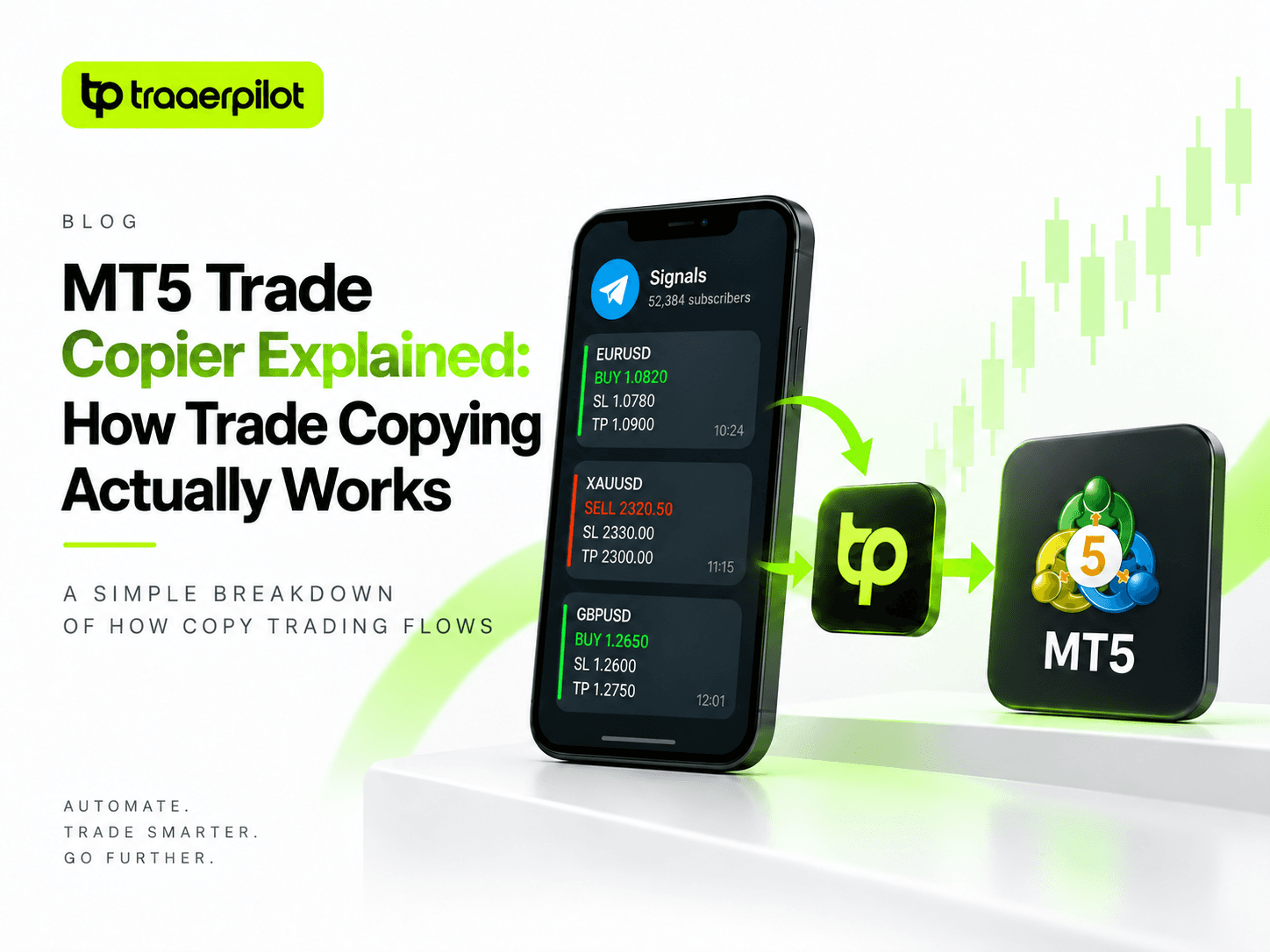
Table of contents
- What Is an MT5 Trade Copier?
- An MT5 trade copier is software that automatically replicates trades from one MetaTrader 5 account to one or more others. When a trade opens, closes, or is modified on the source account, the copier mirrors that action on every connected receiving account — instantly and without manual input.
- The Two Directions Copying Runs
- How the Master–Slave Model Works
- Lot-Sizing Methods: Where Your Risk Is Decided
- MT5 Trade Copier vs PAMM/MAM: The Key Difference
- What Affects Copier Performance
- Common Mistakes With Trade Copiers
- The Takeaway
- Frequently Asked Questions
- The copier built for real execution
What Is an MT5 Trade Copier?
An MT5 trade copier is software that automatically replicates trades from one MetaTrader 5 account to one or more others. When a trade opens, closes, or is modified on the source account, the copier mirrors that action on every connected receiving account — instantly and without manual input.
The source account is the master (or provider). The accounts receiving the trades are the slaves (or receivers). That's the whole model: one account leads, others follow.
The Two Directions Copying Runs
Trade copying serves two distinct goals, and knowing which you need points you to the right tool.
- Account-to-account copying. You replicate trades from one MT5 account to others — your own accounts, or a manager copying to clients. Both accounts exist and the master is a real trading account.
- Signal-to-account copying. There's no master account — the source is a signal, often posted in a Telegram channel. The copier reads the signal text and executes it on your MT5 account. This is where a Telegram signal copier lives.
Same underlying idea (replicate a trade automatically), different source. If your "provider" is a Telegram channel rather than an account you can connect to, you need signal-based copying, not classic master–slave copying.
How the Master–Slave Model Works
In account-to-account copying, the mechanics run like this:
- The master trades. A position opens on the source account.
- The copier detects it. Software monitoring the master account picks up the new trade instantly.
- It maps to each receiver. The copier translates the trade to each connected account — applying that account's lot sizing, symbol names, and risk rules.
- Receivers execute. The trade opens on every slave account, sized appropriately.
- Modifications sync. When the master adjusts a stop, takes partial profit, or closes, every receiver mirrors the change.
The entire loop is automatic. A money manager can trade once and have it replicated across dozens of client accounts; an individual can run one strategy across several of their own accounts at different brokers.
Lot-Sizing Methods: Where Your Risk Is Decided
The most important setting in any copier isn't whether it copies — it's how much. Mirroring a master's raw lot size to a smaller account is how people overexpose themselves. These are the standard methods:
| MethodHow it sizes tradesBest for | ||
| Fixed lot | Every copied trade uses a set lot size | Simple, predictable exposure |
| Multiplier | Receiver's size = master's size × a factor | Scaling up or down proportionally |
| Balance/equity proportional | Sizes relative to each account's balance | Matching risk across different account sizes |
| Risk-based (% per trade) | Sizes so each trade risks a fixed % of the account | Consistent risk regardless of account size |
For most traders, risk-based sizing is the safest default. It keeps every trade risking the same small share of your account no matter how the master is sized, which is exactly what you want when the source account is larger than yours.
MT5 Trade Copier vs PAMM/MAM: The Key Difference
Trade copiers are sometimes confused with managed-account structures. The distinction is custody.
With an MT5 trade copier, your money stays in your own account. Trades are mirrored, and you keep full control — you can adjust risk, pause copying, or close positions yourself. With PAMM or MAM accounts, your capital sits inside a manager's structure and they make the decisions. A copier gives you the replication without handing over your funds.
What Affects Copier Performance
Not all copiers perform equally. These factors separate a reliable setup from a frustrating one:
- Latency. The delay between the master's trade and the receiver's execution. Lower is better — on fast markets, even a second or two changes your fill.
- Reliability/uptime. A copier that runs on a sleeping laptop misses trades. Cloud or VPS hosting keeps it online 24/5.
- Symbol mapping. Different brokers name instruments differently. The copier must map the master's symbols to each receiver's broker.
- Modification handling. Good copiers sync stop moves, partial closes, and follow-up changes — not just the initial entry.
Common Mistakes With Trade Copiers
- Copying raw lot sizes. The fastest route to overexposure. Use risk-based or proportional sizing.
- Ignoring symbol suffixes.
EURUSDvsEURUSD.mwill reject trades silently. Map them. - Running locally on an unstable connection. Missed trades get blamed on the tool. Use an always-on setup.
- Assuming the copier syncs modifications. Confirm it mirrors stop moves and partial closes, not just entries. Some cheap tools only copy the open.
- Skipping the demo test. Every mapping and sizing issue surfaces on demo first, for free.
Expert tip: When you evaluate a copier, judge it on three numbers: execution latency, uptime, and how it handles trade modifications. Those decide whether your receiving accounts actually track the source — everything else is interface.
The Takeaway
An MT5 trade copier replicates trades from a master account to one or more receivers automatically, using lot-sizing methods that decide your real risk. Account-to-account copying needs a master account; signal-based copying (like a Telegram copier) works from a signal instead. Keep your funds in your own account, size trades by risk rather than mirroring raw lots, and judge any copier on latency, uptime, and modification handling. Get those right and copying runs quietly in the background exactly as intended.
Frequently Asked Questions
What is an MT5 trade copier? It's software that automatically replicates trades from one MetaTrader 5 account (the master) to one or more receiving accounts (the slaves). When the master opens, modifies, or closes a trade, the copier mirrors it on every connected account with that account's risk settings.
What's the difference between a trade copier and a signal copier? A trade copier replicates from a source account you connect to; a signal copier reads a signal — often from a Telegram channel — and executes it, with no master account involved. Both automate the same end result but from different sources.
How does lot sizing work in a copier? Copiers offer fixed lots, a multiplier, balance-proportional sizing, or risk-based (percentage) sizing. Risk-based is usually safest, because it makes every trade risk the same small share of your account regardless of how the master is sized.
Do I keep control of my money with a trade copier? Yes. Unlike PAMM or MAM accounts, a copier keeps your funds in your own account. Trades are mirrored, but you can adjust risk, pause copying, or close positions yourself at any time.
Does a trade copier sync stop-loss changes and partial closes? Good ones do — they mirror modifications like stop moves, partial profit-taking, and follow-up closes, not just the initial entry. Confirm this before choosing a tool, as some cheaper copiers only copy the open.
Do I need a VPS to run an MT5 trade copier? It's strongly recommended for account-to-account copying, since the tool must stay online continuously. A VPS or cloud setup keeps the copier running 24/5 so it never misses a trade while your device is off.
The copier built for real execution
TraderPilot brings low-latency, always-on copying to MT5 — from Telegram signals or account to account — with risk-based sizing, symbol mapping, and full modification syncing. Your accounts track the source, hands-free.