What Is Copy Trading & How a Telegram Signal Copier Works
What Is Copy Trading, and How Does It Actually Work? Most traders discover copy trading the same way: they find a Telegram channel posting sharp calls, they mirror a few trades by hand, and then they miss the one setup that would have paid for the month because they were asleep, in a meeting, or three minutes late to the entry. That gap — between a good signal existing and you actually acting on it in time — is the entire reason copy trading exists. And it's why the Telegram signal copier has quietly become one of the most practical tools in a retail trader's stack. This guide breaks down what copy trading really is, the different ways it works under the hood, and how a Telegram signal copier turns a channel message into a live position on your MT4 or MT5 account without you touching the terminal. No hype, no "get rich" nonsense — just how the machinery actually functions and where people get it wrong.

Daniel Brooks
Social Media Manager · August 6, 2026
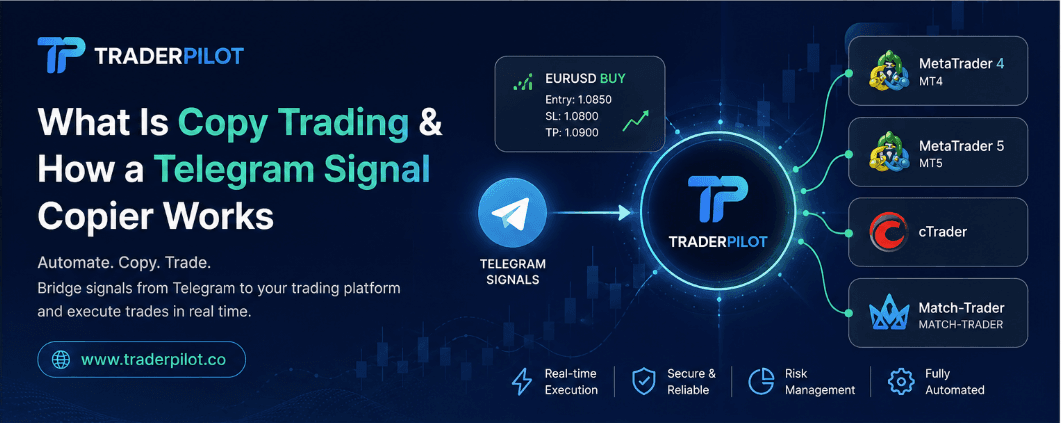
Table of contents
- What Is Copy Trading?
- How Copy Trading Works: The Three Main Methods
- Why signals migrated to Telegram
- What Is a Telegram Signal Copier?
- A Telegram signal copier is software that automatically reads trade signals posted in a Telegram channel or group and executes them on your MetaTrader (MT4/MT5) account in seconds — with no manual input.
- How a Telegram Signal Copier Works: Step by Step
- Where signal formats break — and why parsing is hard
- AI Signal Copiers: Reading Messages That Don't Follow the Rules
- Common Copy Trading Mistakes (and How to Avoid Them)
- Best Practices: Copy Trading Like a Professional
- Is Copy Trading Right for You?
- Frequently Asked Questions
- The Takeaway
- Ready to stop missing entries?
What Is Copy Trading?
Copy trading is the practice of automatically replicating another trader's positions in your own brokerage account. When they open a trade, your account opens the same trade. When they close it, yours closes too — sized to your capital and risk settings.
The appeal is straightforward. You get exposure to a strategy without having to generate the ideas, watch the charts, or time every entry yourself. The trader (or channel, or algorithm) does the analysis. Your job shifts from finding trades to selecting who to follow and managing your risk.
That second part matters more than most people admit. Copy trading doesn't remove risk — it moves it. Instead of betting on your own chart-reading, you're betting on someone else's discipline, and on your own ability to size positions sensibly. Get the risk settings wrong and a profitable signal provider can still blow your account.
How Copy Trading Works: The Three Main Methods
Copy trading isn't one technology. It's a category with several delivery methods, each with different trade-offs around control, transparency, and effort.
| Method How it works Transparency You keep control? Best for | ||||
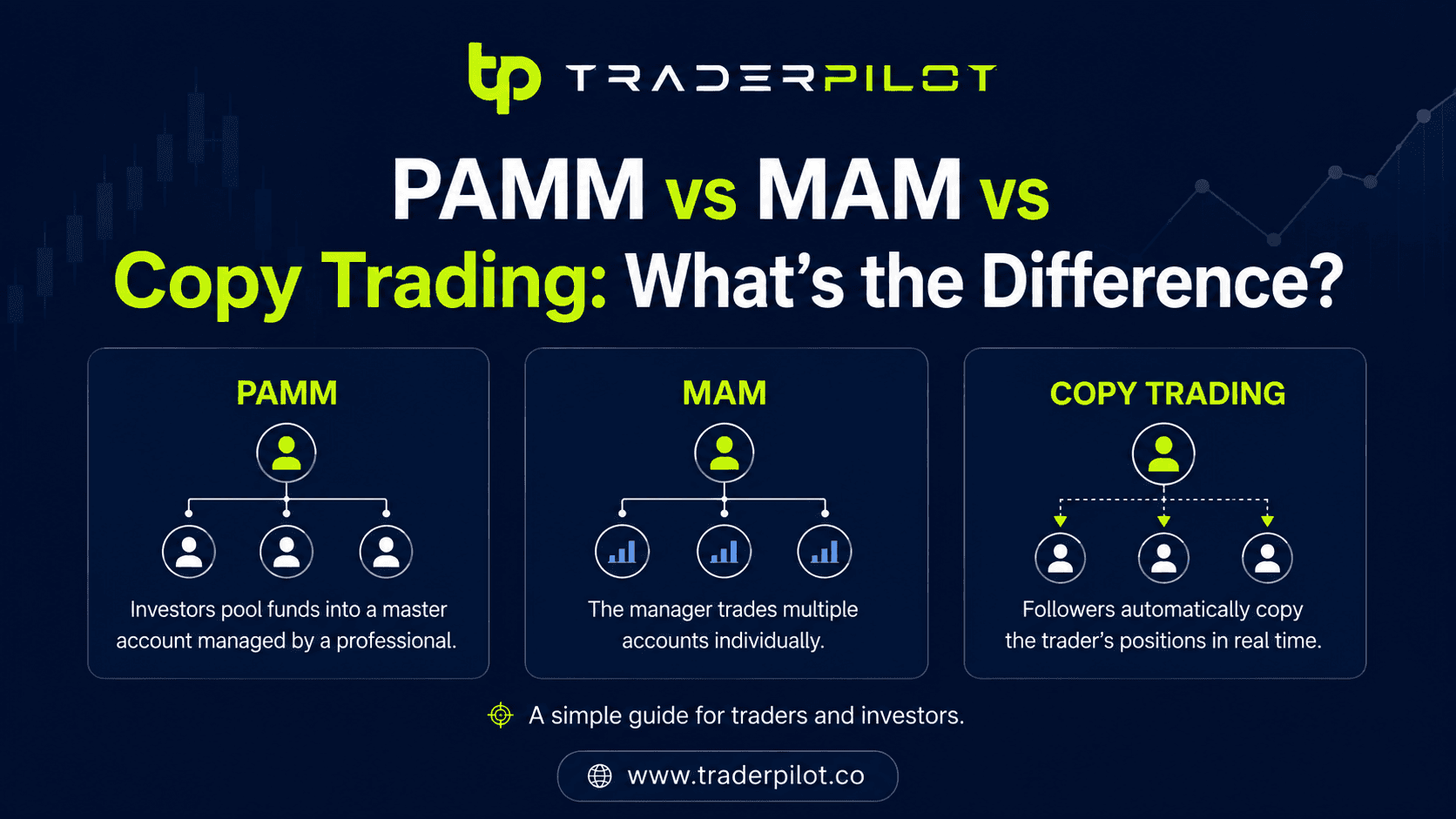
| PAMM / MAM accounts | Your funds sit in a managed pool; a money manager trades on your behalf | Low to medium | No — manager decides everything | Hands-off investors comfortable delegating |
| Social / mirror platforms | You follow traders inside a broker's ecosystem (eToro, ZuluTrade, etc.) | Medium — platform-verified stats | Partial — you choose who, platform executes | Beginners who want a walled-garden experience |
| Signal copiers | Software reads trade signals and executes them on your own MT4/MT5 account | High — you see every order | Yes — full control of settings and funds | Independent traders who want control + automation |
A Telegram signal copier sits firmly in that third category, and it's the one that's grown fastest — because Telegram is already where the signal economy lives.
Why signals migrated to Telegram
Signal providers moved to Telegram for the same reasons everyone else did: instant delivery, group broadcasting, and a format that works on any phone. A provider posts a call — BUY EURUSD @ 1.0850, SL 1.0820, TP 1.0900 — and thousands of subscribers see it at once.
The problem is what happens next. Reading that message and manually placing the order takes time. During that delay, price moves. By the time a subscriber types in the lot size, sets the stop, and hits buy, the entry they got is worse than the one the provider posted. Multiply that slippage across dozens of trades and the "same" signal produces wildly different results for different followers.
A copier removes the human delay entirely.
What Is a Telegram Signal Copier?
A Telegram signal copier is software that automatically reads trade signals posted in a Telegram channel or group and executes them on your MetaTrader (MT4/MT5) account in seconds — with no manual input.
It's the bridge between the message and the market. The provider posts; the copier parses; your broker fills. You define the risk rules once, and the tool handles execution consistently every time a valid signal appears.
Think of it as three jobs happening in sequence: listen, translate, execute.
How a Telegram Signal Copier Works: Step by Step
Here's what actually happens between a channel message and a live position:
- Connection. You link the copier to the Telegram channel(s) you want to follow and to your MT4/MT5 trading account.
- Listening. The copier monitors the channel in real time, watching for new messages.
- Parsing. When a signal arrives, the tool reads the message and extracts the trade details — symbol, direction (buy/sell), entry price, stop-loss, and take-profit levels.
- Risk mapping. It converts those instructions to your account: applying your lot size, your risk-per-trade cap, and any filters you've set.
- Execution. The order is placed on your broker account, usually within a second or two of the message posting.
- Management. As the provider posts updates — move stop to breakeven, take partial profit, close now — the copier applies those changes to your open position automatically.
The entire loop runs without you being at the screen. That's the point: you capture the entry the provider intended, not the one you managed to reach after fumbling with the order ticket.
Where signal formats break — and why parsing is hard
Not every provider posts clean, structured signals. Real Telegram channels are messy. One provider writes EU BUY NOW 1.0850. Another posts a screenshot. A third sends a paragraph with emojis and voice-note vibes. Some edit the original message thirty seconds later to add the stop-loss.
A basic copier that only recognizes one rigid format will miss half of these. This is exactly where the tooling has evolved.
AI Signal Copiers: Reading Messages That Don't Follow the Rules
An AI signal copier uses natural language processing to interpret signals that don't fit a fixed template. Instead of matching an exact pattern, it understands intent — the way a human reader would.
That means it can handle:
- Free-form text — "grab some euro up here, stops below 1.0820" becomes a structured buy order.
- Typos and shorthand —
EURSD,EU,€/$all resolve to EURUSD. - Edited and follow-up messages — recognizing "move SL to entry" as an instruction on an existing trade.
- Mixed languages and slang — common in global channels.
For anyone following providers who don't post in a clean format, AI parsing is the difference between a copier that works on paper and one that works on the channels you actually subscribe to. It's worth confirming a tool's parsing capability against your specific providers before committing — the demo is where you find out whether it reads your signals correctly.
Common Copy Trading Mistakes (and How to Avoid Them)
Most copy trading failures aren't caused by bad signals. They're caused by bad setup. These are the ones that quietly drain accounts:
- Copying with no risk cap. If you mirror a provider's lot sizes without scaling to your balance, one bad streak wipes you out. Always size to your account, not theirs.
- Ignoring spread and broker differences. The provider's broker and yours aren't the same. Different spreads and execution mean your fills won't perfectly match theirs — budget for it.
- Chasing one hot channel. A provider on a three-week winning run isn't a strategy. Concentration risk is real.
- No global equity stop. Set a maximum drawdown at the account level that flattens everything. A single tool malfunction or a provider's blow-up trade shouldn't be able to take the whole account.
- Skipping the demo. Running any copier live before testing it on a demo account is how people discover parsing bugs with real money.
- Copying through high-impact news. Slippage during major releases can turn a tight stop into a much larger loss than the provider showed.
Best Practices: Copy Trading Like a Professional
A few habits separate people who compound from people who churn through accounts:
- Vet providers on verified stats. Look for a track record on a third-party verifier like Myfxbook rather than screenshots. Screenshots are marketing; verified equity curves are evidence.
- Start small and scale on proof. Fund a copier with an amount you'd be comfortable losing entirely, and only add capital once the results hold up on your account, not the provider's.
- Diversify across a few providers. Uncorrelated strategies smooth the equity curve better than one star performer.
- Cap risk per trade. A fixed percentage per position (many traders use 0.5–1%) keeps any single call from mattering too much.
- Log everything. Keep records of fills versus posted signals so you can measure your real slippage and drop providers whose edge doesn't survive execution.
Expert tip: The best signal in the world is worthless if you can't act on it consistently. Judge a copier less on features and more on two things — how fast it executes, and how reliably it reads the channels you actually follow.
Is Copy Trading Right for You?
Copy trading suits traders who have capital and conviction but not the time to sit at charts all day. It's a fit if you want systematic exposure without becoming a full-time analyst, and if you're willing to treat risk management as your job even when someone else generates the trades.
It's a poor fit if you're looking for a hands-off money machine. The automation handles execution — it does not handle judgment. Choosing providers, setting risk, and pulling the plug on underperformers is still on you.
Frequently Asked Questions
What is a Telegram signal copier? A Telegram signal copier is software that automatically reads trade signals from a Telegram channel and executes them on your MT4 or MT5 account. It removes the manual delay between a signal being posted and the trade being placed, so you capture entries closer to what the provider intended.
Is copy trading legal? Yes, copy trading is legal in most countries, and many brokers actively support it. Rules vary by region, and some jurisdictions regulate managed-account structures more tightly than simple signal copying, so it's worth checking your local financial regulations and your broker's terms.
Do I need coding skills to use a signal copier? No. Modern signal copiers are built for traders, not developers. You connect your Telegram channel and MT4/MT5 account, set your risk preferences, and the tool handles parsing and execution automatically.
How fast does a Telegram signal copier execute trades? A good copier typically places a trade within one to two seconds of the signal being posted. Actual fill speed also depends on your broker's execution and market conditions, but the copier eliminates the biggest delay — the human one.
Can a signal copier read signals that aren't in a fixed format? Basic copiers usually need a consistent format, but an AI signal copier uses natural language processing to interpret free-form messages, shorthand, and typos. This matters because most real Telegram providers don't post in a clean, uniform structure.
Will my results match the signal provider's exactly? Rarely, and you should expect small differences. Your broker's spreads, execution speed, and the moment your order fills all differ slightly from the provider's, so your equity curve will track theirs closely but not identically.
How much money do I need to start copy trading? There's no universal minimum — it depends on your broker and the lot sizes your providers use. The safer approach is to start with an amount you can afford to lose entirely, confirm the results on your own account, and scale up only after that.
What's the biggest risk in copy trading? Poor risk management, not bad signals. Copying oversized positions, skipping a global equity stop, or over-concentrating in one provider causes most account losses — all of which are within your control to prevent.
The Takeaway
Copy trading works by replicating a proven trader's positions in your own account, and a Telegram signal copier is the most direct way to do it when your signals live on Telegram. It reads the message, maps it to your risk, and executes on MT4/MT5 in seconds — closing the gap between a good call existing and you actually being in the trade.
The technology handles execution flawlessly. What it can't do is choose good providers or set your risk for you — that's still the part that decides whether copy trading builds an account or burns one. Get the setup right, test on demo first, and treat every provider as a hypothesis you're willing to drop.
Ready to stop missing entries?
TraderPilot connects your Telegram channels straight to your MT4/MT5 account and executes signals automatically — with AI parsing that reads the messy, real-world formats other copiers choke on. Set your risk once, and never manually punch in a signal again.